
Optimizing Commercial Gates: Manual to 10-Second Check-In
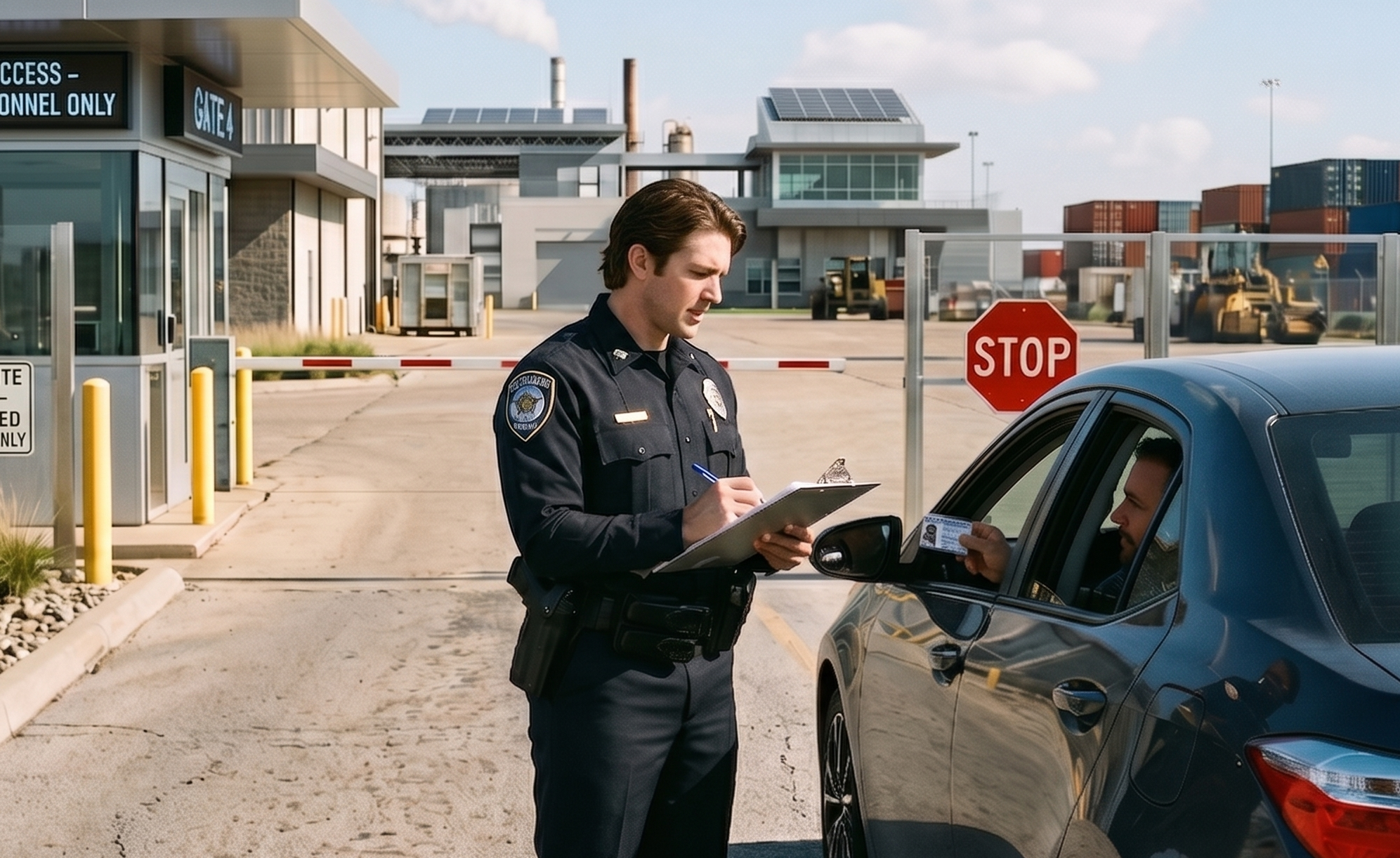
Walk into the average manufacturing plant, distribution center, or industrial facility, and you'll find millions of dollars of materials, equipment, and inventory moving through every day.
Then a truck rolls up to the gate.
The driver waits while the guard steps out of the shack and works through the questions at the window: name, company, who they're here to see. Then the guard heads back inside to call the department and confirm the visit is cleared. No answer. Back to the window for another contact. Back inside to try a different extension, holding on the line for someone to say the driver is good to go. While that plays out, the guard logs the visit by hand, typing the name into an Excel sheet on the computer, or worse, scrawling it onto a clipboard. By now a second truck has pulled in behind the first. Then a third.
That gap, between the technology guarding the perimeter and the clipboard guarding the gate, is where most sites are quietly exposed. And the data shows this blind spot isn't an anomaly. It's the norm.
Why the Front-Gate Clipboard Fails
- It's slower than you think: Industry data shows most sites take one to five minutes per visitor, and a queue of trucks turns that into a real bottleneck at the gate.
- It's a security and privacy gap: Handwritten names get zero verification, the open log exposes every prior visitor, and the paper trail can't survive an audit.
- The fix isn't a capital project: A hardware-free, tablet-based system like Gate Sentry lets departments add visitors, lets visitors self-register their details, and clears each arrival in about ten seconds, no kiosks, servers, or trenching required.
What This Guide Covers
- The blind spot, by the numbers
- The hidden cost of time at the gate
- The data link between digital tracking and real security
- 5 ways paper and spreadsheets silently fail your site
- Closing the gap: what Gate Sentry does for guards
- Where to start: a fast, low-disruption rollout
- Frequently asked questions
The Blind Spot, By the Numbers
This isn't a problem confined to a few small, outdated sites. Modern security data reveals a widespread operational blind spot in commercial sites like manufacturing plants, warehouses, distribution centers, and industrial facilities.
The tracking gap. According to ASIS International's research report, The Essentials of Access Control: Insights, Benchmarks, and Best Practices, 39 percent of organizations reported using a manual system, such as pen and paper or a spreadsheet, to keep track of temporary credentials issued to visitors.
The excuses for inertia. When asked why they haven't modernized, 29% cited insufficient visitor traffic to justify a change, while 28% said digital systems were simply too expensive or cost-prohibitive.
But the reality is the clipboard isn't saving anyone money. It's quietly costing them, every single day, in the one resource a busy gate can't get back: time.
The Hidden Cost of Time at the Gate
Beyond the security vulnerabilities, manual tracking creates a massive drag on operational efficiency. The ASIS report analyzed exactly how much time is wasted just getting a visitor into a site. Removing those who didn't know, the data paints a clear picture of slow processing times:
- 1 to 5 minutes: The vast majority (62 percent) reported that processing a visitor took between one and five minutes per person.
- 6 to 15 minutes: One in ten (10 percent) admitted it took between six and fifteen minutes.
- Over 15 minutes: An unfortunate 2 percent said the process dragged on for longer than fifteen minutes.
- Under a minute: Only a tiny fraction (14 percent) processed a visitor in less than a minute. The remaining 7 percent said it varied greatly depending on circumstances.
When multiple contractors, delivery drivers, or auditors arrive simultaneously, those minutes compound. A five-minute processing time turns into a twenty-minute traffic jam at the gatehouse.
The Data Link Between Digital Tracking and Real Security
The hesitation to upgrade usually stems from a belief that the clipboard is "good enough." But the data reveals a direct correlation between digital visitor tracking and how well a facility's security actually functions.
According to the ASIS report's effectiveness correlations, moving from paper to digital transforms security leadership's confidence:
Overall confidence boost. Organizations with a visitor management system reported significantly higher confidence in their overall access control system (70% confident) compared to those stuck on manual processes (just 54% confident).
Perceived system effectiveness. Likewise, facilities using Physical Identity and Access Management (PIAM) or digital tracking for temporary credentials were roughly 20 percentage points more likely to rate their system as highly effective than those using manual tracking or no credentials at all.
5 Ways Paper and Spreadsheets Silently Fail Your Site
A paper logbook feels harmless because it's familiar. But the idea that your site has "insufficient traffic" to warrant an upgrade ignores a critical truth: a security gap only needs to be exploited once. The passive failures of an analog approach create real operational and security liabilities.
1. It can't account for people in an emergency. A paper page is a historical record of who signed in, not a real-time tracker of who is still on the property. When an alarm sounds and you need an accurate headcount at the muster point, "go find the binder" is a liability, not an evacuation plan.
2. It accepts everything at face value. A handwritten name offers zero verification. There's no ID cross-referencing, no automated screening against your internal do-not-admit list, and no digital audit trail of who authorized the visit.
3. It's an open privacy breach. Every time a visitor signs a physical sheet, they can read the names, companies, and arrival times of every contractor, competitor, and auditor who came before them. It's a compliance problem that's nearly impossible to defend to a regulator.
4. It creates costly bottlenecks. Manual entry forces security officers to act as data-entry clerks. When the vast majority of organizations need anywhere from one to fifteen minutes to process a single guest, a queue of high-ticket contractors waiting at the gate is wasted labor on one side of the window and wasted billable time on the other.
5. It subverts compliance audits. When an auditor asks you to prove exactly who was on-site three Tuesdays ago, an illegible, incomplete paper log turns a five-minute digital query into a frustrating afternoon of digging through storage boxes.
Closing the Gap: What Gate Sentry Does for Guards
The 28% who call digital systems "too expensive" are picturing the wrong thing: traditional, legacy enterprise software that demands costly IT infrastructure, wired callboxes, local servers, and specialized hardware. That world is exactly why the clipboard survived this long.
Gate Sentry throws it out. There's no hardware to buy, nothing to wire, and nothing to trench. It's a 100% hardware-free SaaS platform that runs on the tablets your guards already carry, so the "too expensive" objection disappears, and so does the time the old process was quietly bleeding from every shift. Built specifically for industrial environments, manned gates, and logistics docks, it replaces the vulnerable clipboard with a ruggedized, mobile solution that's cost-effective, deployment-ready, and fast.
| Feature | Clipboard & Excel Sheets | Gate Sentry Tablet Software |
|---|---|---|
| Identity Verification | Blind trust of handwritten names | Instant ID scanning & watchlist checks |
| On-Site Headcount | Static record of past arrivals | Real-time, live on-site headcount |
| Data Privacy | Publicly exposes prior visitor data | Encrypted, private visitor records |
| Check-In Speed | 1 to 15 minute bottleneck at the gate | ~10-second scan clears the line |
| Guard Mobility | Bound to a fixed, interior desk | Handheld mobility for vehicle lanes |

1. Mobility Built for the Vehicle Lane
Traditional visitor systems assume guests walk up to an interior desk. Gate Sentry runs natively on portable tablets, so your security officers can step out of the guardhouse directly to a truck window or vehicle door. With full database access in hand, guards stay mobile and vigilant instead of tethered to a counter.
2. The "10-Second" Check-In via SentryPass
Gate Sentry erases the 1-to-15-minute gate bottleneck through decentralized pre-registration:
- Departments add their expected visitors directly in the app, so the gate knows who's coming before they arrive.
- Visitors then pre-register their own information ahead of time, ID, license plate, required forms, and whatever else your property demands, so nothing has to be collected at the window.
- Each visitor receives a digital SentryPass sent straight to their Apple Wallet or Google Wallet.
- On arrival, the guard scans the smartphone pass with the tablet's camera. The profile populates instantly, the guard taps approve, and the vehicle moves through in about ten seconds.
3. Industrial-Grade Verification and Document Capture
Gate Sentry stops relying on basic text inputs. Officers can use the tablet's camera to photograph driver's licenses, capture vehicle license plates, record carrier names, and log specific dock door assignments. Every piece of data is immediately tied to a secure, timestamped digital profile.
4. Visitor Lists That Update in Real Time
When a department adds a visitor or vendor to the expected list, it's there at the gate the moment the guard checks, no phone call to the shack required. The list updates instantly across every device, which means fewer interruptions for security, fewer missed entries, and a visitor experience that doesn't depend on whether someone remembered to make the call.
5. Zero-Hardware Infrastructure & Total Offline Continuity
Gate Sentry answers the "too expensive" objection by being a 100% hardware-free SaaS platform. There are no callboxes to wire, no data lines to trench, and no local servers to maintain. And if your facility loses Wi-Fi or cellular service, Gate Sentry keeps working completely offline, logging traffic locally and syncing to the cloud automatically the moment connectivity returns. Your security posture never freezes.
An honest look at the ROI: We won't throw inflated vendor percentages at you. You don't need exaggerated marketing statistics to see the flaw in the current system. You just have to picture your current clipboard during a real emergency, a high-traffic rush, or a strict compliance audit. The vulnerability is self-evident.
Where to Start: A Fast, Low-Disruption Rollout
You don't need to rip and replace your entire access control infrastructure or clear out a massive budget to fix this. Because Gate Sentry is hardware-free, there's no construction window, no IT buildout, and no capital project to clear, most sites are fully live at the gate within two to four weeks. The front gate is a contained, high-impact environment where you can move the needle quickly:
- Deploy Gate Sentry tablet software to your frontline guard shacks and reception points.
- Enforce pre-registration so departments and hosts take ownership of inviting their own visitors, and let visitors self-register their details via mobile wallets.
- Automate ID verification and real-time watchlist screening right at the vehicle window.
- Integrate your digital guest roster into your active muster and emergency evacuation protocols.
The clipboard was never a strategic decision. It was just the default option left over from a different era. Replacing it is one of the fastest, most cost-effective upgrades you can make to your facility's actual security posture.
Ready to eliminate the clipboard bottleneck at your guard shack?
See how Gate Sentry clears the line, drives up security confidence, and secures your perimeter, built for the industrial gate, not the corporate office lobby.
Schedule a DemoOptimize Your Gate Operations with Gate Sentry
Gate Sentry is a visitor and vendor management platform engineered specifically for high-volume commercial and industrial sites. We secure gates for regional warehouses, manufacturing plants, cross-docks, and distribution hubs. Learn more at gatesentry.com.
Frequently Asked Questions
How long does manual visitor check-in actually take at an industrial gate?
Industry research from ASIS International found that 62% of organizations take one to five minutes to process a single visitor, 10% take six to fifteen minutes, and only 14% process a visitor in under a minute. When multiple trucks arrive at once, those minutes compound into a traffic jam at the gate.
Does a digital visitor management system actually improve security, or just speed?
Both. ASIS data shows organizations with a visitor management system reported 70% confidence in their overall access control versus just 54% for those on manual processes. Facilities using digital or PIAM tracking for temporary credentials were roughly 20 percentage points more likely to rate their system highly effective.
What happens at the guard shack if our internet goes down?
Gate Sentry's guard tablets feature full offline capability. Guards continue screening visitors, scanning passes, and capturing entries without interruption. All logs sync automatically once connectivity is restored.
Source
ASIS International, The Essentials of Access Control: Insights, Benchmarks, and Best Practices (2023). All visitor-processing, confidence, and credential-tracking statistics cited above are drawn from this report.