
Inside the Gatehouse: An Insider Conversation on Why HOA Visitor Management Had to Change
A story from the Vision InSites Podcast with host Chris Anderson
When Gate Sentry founder Mike Rendon sat down with Vision InSites host Chris Anderson, it created a conversation you do not often hear in the security world. Chris is a highly respected industry veteran with more than thirty years of experience as a private security operator, coach, mentor, and educator. He is also the founder of Silvertrac, one of the first real-time digital reporting platforms, and has spent decades working directly with guard companies to improve operations, accountability, and performance.
Mike brings a complementary perspective shaped by a background in corporate strategy, including leadership roles at American Airlines and Alcon Labs, along with HOA leadership experience and years spent running guard operations himself. Together, their conversation blends deep operational knowledge with practical, real-world insight from both sides of the gatehouse.
Seeing the Gatehouse Clearly for the First Time
Gate Sentry did not begin as a business plan. It began the day Mike stepped inside his own community’s gatehouse and saw guards drowning in chaos. Names were scribbled on loose sheets of paper scattered across the desk. Calls and texts were coming in nonstop. Residents were honking at the window. Vendors were appearing without warning. In that moment, the industry’s three hundred percent turnover rate made perfect sense. The guards were doing everything they could, but they had no functional system to support them.
What stood out to Mike was how dramatically the world had evolved while visitor management technology had not. The systems available were outdated, clunky, and dependent on heavy hardware. None of them would meaningfully improve what he was seeing. Even if he installed one, it would still feel like a slightly cleaner version of the same paper-based chaos.
“The people were not failing,” Mike says in the episode. “The process and the software were.”
That realization set everything into motion.
A Tool Built Out of Necessity, Not Ambition
The first version of Gate Sentry was barely a system at all. It was simply a cleaner visitor list meant to help the guards in Mike’s neighborhood. But each time the guards ran into a problem, Mike and his team fixed it, and each fix revealed something else that needed attention.
Residents needed a way to manage their own visitors, so he created a basic list system that eventually grew into a full portal and mobile app. Administrators needed visibility into visitor history and user management, so the portal expanded again. Power outages kept taking down computers, so the software had to run reliably on a tablet. Traffic was backing up at the gate, so the workflows had to get faster and more efficient.
There was no grand roadmap, only the next real world bottleneck to solve.
Before long, visitors from other communities began asking what system was being used. And almost without planning it, Gate Sentry started spreading far beyond Mike’s neighborhood.
Becoming a Guard Operator: The Unexpected Pivot
One board demo changed everything. After seeing Gate Sentry in action, a board member asked Mike a question that temporarily redefined his entire role.
“This works great. Could you run our guard company too?”
Mike laughed when he told the story. He had never operated a guard company, but he understood the problems well enough to help, so he agreed.
That single yes grew into ten guard sites across Dallas Fort Worth and became an invaluable incubator for Gate Sentry’s development. Mike’s engineers spent months inside guardhouses, watching the everyday details that make or break security workflows.
“We built the software around the way guards actually work,” Mike explains. “Not the way people assume they work.”
This hands on development style became the foundation of Gate Sentry’s identity. The team would innovate continuously and always in response to real conditions. Years later, Mike sold the guard company so he could focus entirely on building the visitor management platform.
The Shift to Nameless and Faceless Traffic
One of the most eye opening moments in the episode is Mike’s explanation of how gate traffic has changed and why so many communities have not realized how significant that shift has become.
“Ten years ago, you recognized everyone coming in,” Mike says. “Your landscaper, your housekeeper, your family. Today it is nameless and faceless traffic arriving from apps.”
Gig drivers do not know community rules. Many are using borrowed accounts. They come and go quickly with no connection to the residents or the property.
In a situation like that, relying on a guard’s memory or on a handwritten description such as white SUV or delivery guy maybe twenties is not real security.
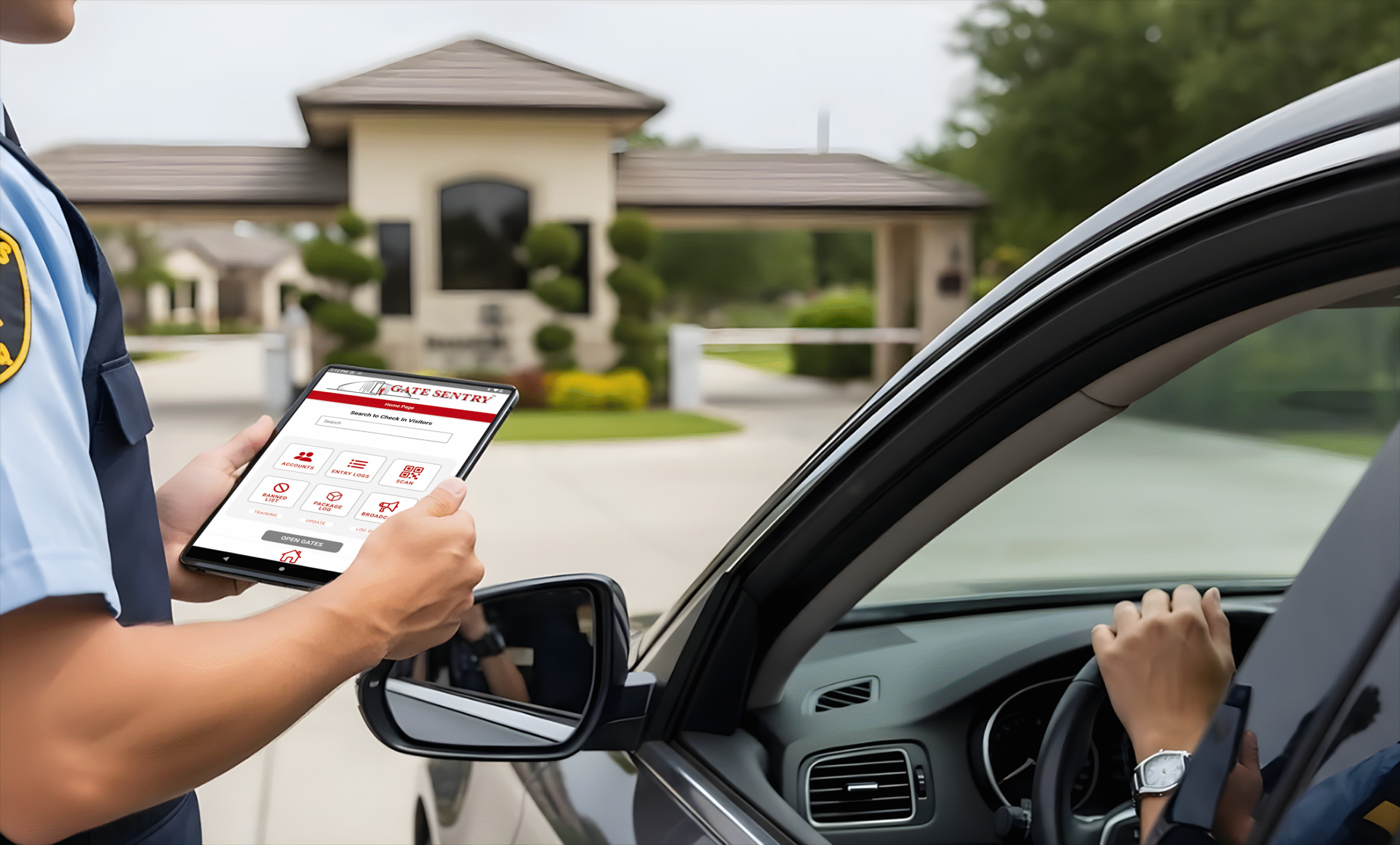
This shift pushed Gate Sentry toward more precise digital verification and laid the groundwork for one of the platform’s most important innovations, a security tablet that captures identification and license plate information.
Built to Make Guard Work Easier
A major theme in the conversation is how Gate Sentry improves daily life for guards. HOA guards are not sitting behind a desk. They are walking out to cars, checking identifications, solving confusion at the window, and managing a constant flow of traffic.
Every part of Gate Sentry was shaped around that reality. Fast tap to go workflows, stored identifications, dynamic search functionality, and training that takes less than an hour. One of the more recent innovations, SentryPass, a mobile pass saved to a visitor’s phone wallet, allows for a three second VIP style check in that streamlines the process even further for the guards.
Guards embraced it quickly. Turnover dropped. Consistency improved. Residents and visitors finally experienced a gate process that felt modern, efficient, and reliable.
Reinventing the Back Gate: The VirtualKeypad
Once communities adopted Gate Sentry at the main gate, they all began asking the same question. What about the back gate, the pool, the clubhouse, and all the other entrances without on site security?
Most secondary access points still rely on old metal keypads, devices whose core technology has not meaningfully changed in fifty years. Even the versions with touchscreens suffer from the same issues. They are expensive, they break down, they rust, they freeze, they require wiring, and they usually rely on a single shared code that spreads far beyond the community.
Mike reframed the problem from the ground up.
“Why install an expensive keypad when every visitor already has a smartphone?”
That idea sparked the VirtualKeypad, a completely hardware free access method. Properties mount a weatherproof QR sign. Visitors scan it, a keypad appears instantly in their web browser, and their code is verified in the cloud.
- No wiring needed.
- No shared codes.
- No vandalism.
- No expensive repairs.
The VirtualKeypad now works across a wide range of environments. HOA back gates, pools, and clubhouses, as well as commercial complexes, manufacturing facilities, and even remote Canadian storage sites where traditional metal keypads routinely fail in severe weather.
The Data That Eliminated the Overnight Guard Shift
Halfway through the podcast, Mike shares a data point that often stops property managers in their tracks. The team realized that the VirtualKeypad could replace the need for overnight guards, especially as security companies continue to grow more expensive.
Across millions of logs, Gate Sentry found that most communities average fewer than one visitor between midnight and six in the morning.
Yet HOAs regularly spend more than one hundred thousand dollars each year staffing that shift.
“You are paying a full salary to open the gate for one car,” Mike says. “It does not make sense anymore.”
The VirtualKeypad keeps digital verification, accurate tracking, and resident notifications fully intact without requiring someone to sit in a guardhouse for eight empty hours. It is another example of innovation driven by real data rather than assumptions.
A Conversation Worth Hearing
The full episode offers a candid look at how real world gate operations actually work and how innovation happens when someone is willing to sit in the guardhouse long enough to understand what is broken. Mike and Chris explore the changes shaping gated communities, the pressure on guard companies, and the practical solutions that emerged through Gate Sentry’s hands on development.
For anyone involved in property management, security operations, or community leadership, the discussion offers valuable insight into where access control is heading and what modern gate security should look like.
Listen to the Full Interview
Hear the full conversation with Gate Sentry Founder Mike Rendon on the Vision InSites Podcast.
Listen Now