
HOA Reserve Study: How to Cut Access Control Costs
Walk into the annual budget meeting of any gated community, and you'll find the same stressful document spread across the table: the HOA Reserve Study.
The board sifts through the financial projections line by line. The clubhouse pool needs resurfacing. The private community roads are beginning to spiderweb with cracks and require structural paving. Then, you hit the line item for gated property access control.
Typically, a reserve engineer flags the front gate for a massive capital overhaul. The keypads are glitching, the fob readers are obsolete, the visitor kiosk is constantly offline, and the License Plate Recognition (LPR) system needs a total hardware replacement. Suddenly, tens — or even hundreds — of thousands of dollars from your HOA reserve fund are earmarked just to keep a physical box at the entrance running.
That massive line item isn't an unalterable reality. It's an unnecessary financial trap. When your reserve engineer reviews future spending and reserve fund needs, don't let them saddle your community with exorbitant costs to replace outdated, physical hardware.
Why Legacy Gate Hardware Bleeds HOA Reserves Dry
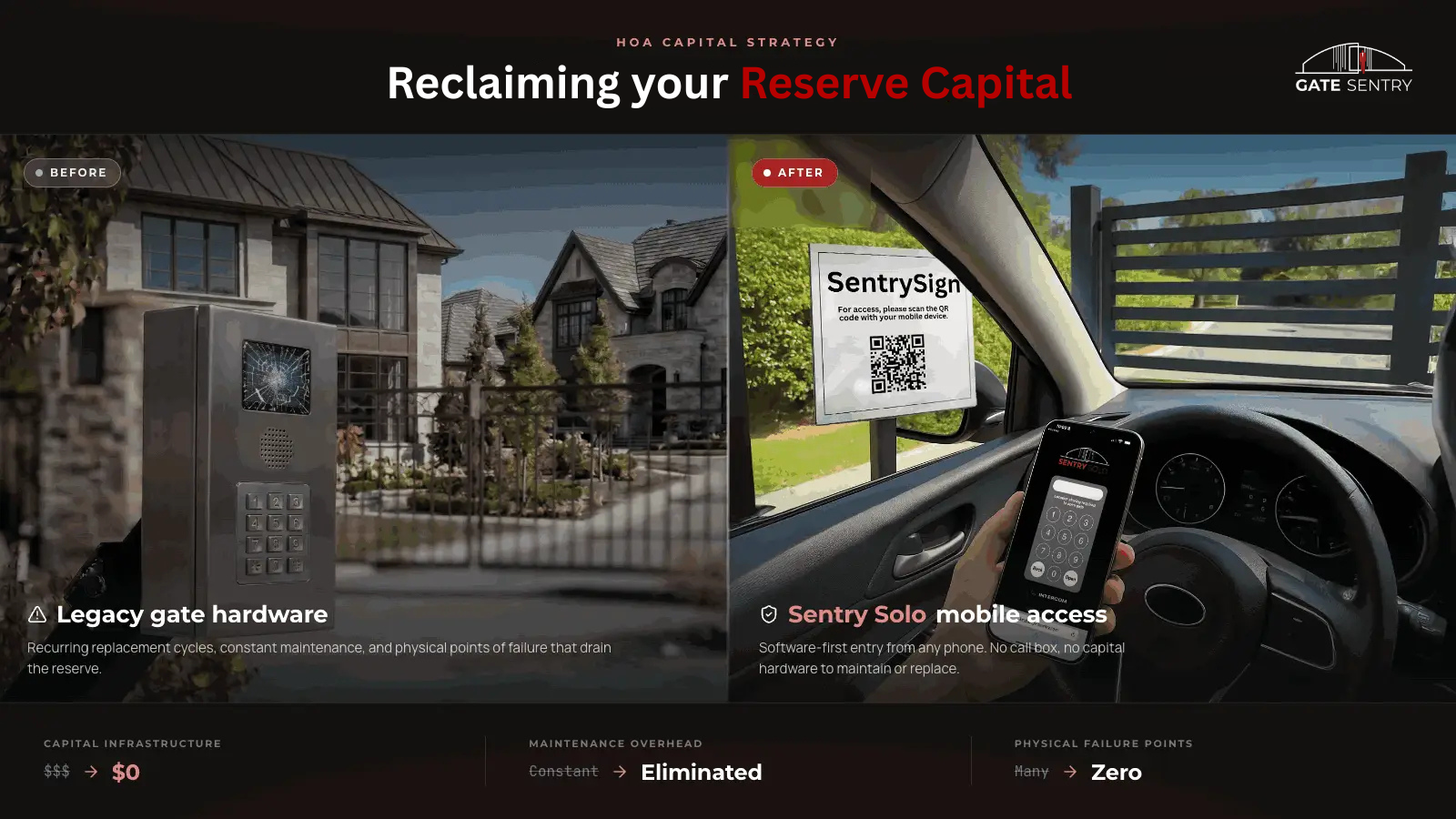
Traditional gated property access control relies on physical hardware (keypads, kiosks, fobs) that frequently breaks down and drains HOA reserve funds. Modern virtual access control solutions like the Sentry Solo VirtualKeypad and Virtual-Intercom eliminate physical infrastructure entirely. Shifting to mobile-only technology removes gate hardware from your HOA Reserve Study completely, allowing boards to redirect capital to high-priority infrastructure like private street repairs and pool upgrades.
- Vulnerability to Environmental Hazards: Physical entry boxes get struck by lightning, vandalized, or hit by moving vehicles, turning a predictable lifecycle into an emergency capital expense.
- Rapid Tech Obsolescence: Legacy access control systems lock your community into proprietary hardware cycles that require total, expensive "rip-and-replace" upgrades every few years.
- The Virtual Access Shift: By transitioning to mobile-only technology like Sentry Solo, communities are eliminating entry hardware altogether, redirecting vital reserve funds back into the community assets that actually protect property values.
What This Guide Covers
- The reserve fund trap: why gate infrastructure eats your budget
- 5 ways physical entry systems quietly drain HOA capital
- How Gate Sentry pioneered virtual access control
- Sentry Solo VirtualKeypad & Virtual-Intercom (visitor access)
- Gate Sentry VirtualKey (resident access) & reclaiming your reserve fund
- Where to start: a fast, low-disruption update to your reserve plan
The Reserve Fund Trap: The Real Cost of Access Infrastructure
According to Association Reserves — the nation's leading provider of Reserve Studies — HOAs should be setting aside 15% to 40% of their total assessments toward their Reserve Fund. Keeping those funds healthy ensures the board can respond to major structural needs without imposing sudden, deeply unpopular special assessments on homeowners.
But when a reserve engineer builds a 30-year funding plan, they look at the historical lifecycle of your gate hardware. They see keypads, fobs, kiosks, and LPR cameras, and they project a repeating cycle of expensive replacement costs.
The reality? The clipboard of the commercial logistics world is the physical keypad of the residential world: a legacy approach surviving simply because "that's the way it's always been done." A neighborhood shouldn't have to choose between fixing its private roads or replacing a fried circuit board at the front gate.
5 Ways Physical Gate Hardware Silently Fails Your Community
Physical entry infrastructure feels essential because it's tangible. However, relying on heavy hardware at your gated perimeter creates ongoing operational vulnerabilities and financial liabilities.
1. High Vulnerability to Environmental Hazards
A single summer thunderstorm with a well-placed lightning strike can completely fry an integrated entry system. Add in intentional vandalism or a distracted delivery driver backing into a kiosk, and your reserve projections are instantly thrown off by emergency repairs.
2. Constant, Expensive Maintenance Contracts
Keypads break down, mechanical parts wear out every few months, and proprietary software licenses must be renewed. This creates a death-by-a-thousand-cuts scenario for your operating budget.
3. Proprietary Ecosystem Lock-In
When a fob manufacturer decides to sunset a specific model of reader, your HOA is forced into an expensive, community-wide hardware replacement cycle just to keep residents moving through the gate.
4. Rapid Depreciation, Rising Capital Costs
Unlike roads or roofs, which offer long-term stability, gate technology changes fast. Spending $50,000 on a visitor kiosk today means saving up to spend another massive chunk in a few years for a machine that does the exact same thing.
5. Starving High-Priority Neighborhood Amenities
Every dollar allocated to replace a visitor kiosk or an array of LPR cameras is a dollar stolen from much-needed private HOA street repairs, clubhouse pool upgrades, or roof replacements — the very assets that directly drive neighborhood property values.
Eliminating Capital Expense: Sentry Solo for HOAs
The era of spending thousands on entry pedestals, loops, and callboxes is over. Gate Sentry has revolutionized access control by eliminating this costly, unnecessary hardware entirely.
Gate Sentry pioneered virtual access control using mobile-only technology. Through the Sentry Solo VirtualKeypad and Virtual-Intercom, the smartphone in your resident's or visitor's pocket replaces the physical box at the curb. There is no infrastructure to trench, no wiring to run, and no physical terminal to get smashed or vandalized.
Side-by-Side: Legacy Gate Infrastructure vs. Sentry Solo
| Feature | Legacy Gate Hardware (Keypads, Fobs, Kiosks) | Sentry Solo Mobile-Only Technology |
|---|---|---|
| Capital Infrastructure Cost | High (Trenching, wiring, pedestal terminals) | Zero (100% cloud & mobile-based) |
| Weather & Environmental Risk | Fried by lightning, broken by freezing weather | Immune (No physical hardware at the gate) |
| Vandalism & Vehicle Strikes | Frequent, high-cost emergency repairs | Eliminated (Nothing at the curb to hit) |
| Ongoing Maintenance Fees | Constant service calls and hardware contracts | Zero maintenance overhead |
| Reserve Study Allocation | Significant, repeating 5-to-10-year capital hit | Removed completely from capital liabilities |
Sentry Solo VirtualKeypad (Visitor Access)
The VirtualKeypad replaces the physical keypad at unmanned gates — but the device that runs it is the visitor's own phone, not a plastic box bolted to a pedestal at the curb. When a resident adds a visitor in the Gate Sentry app (just a phone number or email), the visitor automatically receives a digital pass with a unique 5-digit access code that can be saved to Apple or Google Wallet.
At the gate, the visitor scans the QR code on the SentrySign to open the VirtualKeypad in their phone's browser — no app required — enters their access code, and the gate opens. The resident gets a notification the moment their guest arrives.
Sentry Solo Virtual-Intercom (Visitor Backup)
For visitors who don't have a pre-issued access code, the Virtual-Intercom provides a fast, secure backup — no thousands-of-dollars visitor kiosk required. After scanning the QR code at the gate, the visitor taps the Intercom button below the VirtualKeypad.
A blank search field appears. As the visitor types the resident's address, matching addresses populate — resident names are never shown. The visitor selects the address and places a secure call directly through the Gate Sentry software. The resident's personal phone number is never shared, and they can grant entry with a single tap from anywhere in the world.
Gate Sentry VirtualKey (Resident Access)
While Sentry Solo handles visitor access at the gate, residents use VirtualKey — a feature inside the Gate Sentry mobile app — to open entrances from their own phones. It's especially useful when a resident is in a car service or loaner vehicle without their normal credentials, or on foot heading to amenities like the pool, clubhouse, or workout room.
Residents tap the VirtualKey button on the app's Profile page, select the desired gate or entrance, and it opens. Each use is automatically logged in Visitor History as "Resident Access" — giving the HOA a complete audit trail without a single physical fob, reader, or keycard to manage.
Freedom From the Maintenance Loop
Because Sentry Solo runs purely on mobile-only architecture, your HOA cuts the cord on hardware that breaks down every few months. No more ordering replacement fobs, no more cleaning out insect nests from intercom boxes, and no more tracking down specialized technicians for proprietary systems.
Reclaiming Your HOA Reserve Fund
When your reserve specialist conducts their next site visit, you can confidently tell them to strike access control hardware from the list of future capital requirements. That immediately frees up tens of thousands of dollars to be reallocated toward long-term community enhancements like landscaping, paving, and amenity upgrades.
Where to Start: Update Your Reserve Study, Protect Your Budget
Modernizing your community's gate system doesn't require a disruptive construction project. In fact, because Sentry Solo is completely virtual, it is one of the fastest, lowest-impact upgrades an HOA board can execute:
- Review your current HOA Reserve Study: Identify exactly how much capital is currently scheduled for access control hardware replacement over the next 5 to 20 years.
- Deploy Sentry Solo: Transition your neighborhood to the Sentry Solo VirtualKeypad and Virtual-Intercom with zero downtime, zero trenching, and zero upfront hardware expenses.
- Instruct your reserve engineer to remove the hardware line item: Have the specialist adjust your funding goals to reflect a hardware-free perimeter.
- Redirect the savings: Watch your reserve funding percentage climb as those saved dollars are safely earmarked for private street repaving or upgrading the clubhouse pool.
Physical gate hardware wasn't a strategic choice; it was simply the only option available for decades. Gate Sentry has changed the game. By moving to a virtual, mobile-only model, you protect your perimeter, protect your budget, and invest your community's money where it actually matters.
An honest look at the ROI: You don't need exaggerated marketing statistics to see the flaw in the current system. You just have to picture your current entry pedestal during the next severe lightning storm or high-traffic weekend rush. The vulnerability — and the cost — is self-evident.
Ready to eliminate the gate hardware bottleneck and protect your community's reserve fund?
See how Gate Sentry can replace your physical gate infrastructure with a fully virtual, mobile-only solution — and free up your reserve fund for the things that actually matter.
Schedule a Demo with Gate Sentry TodayOptimize Your HOA Operations with Gate Sentry
Gate Sentry is a premier access control platform engineered specifically to eliminate the high costs of physical property management. We secure perimeters for master-planned communities, luxury subdivisions, and multi-family developments nationwide. Learn more at gatesentry.com.