
Manufacturing Visitor Management System: A 2026 Guide
Walk up to most manufacturing gates today and you'll still see the same scene from twenty years ago: a clipboard, a paper logbook, a guard squinting at a driver's license, and a line of trucks idling behind the boom gate. It's slow, it's error-prone, and when someone asks for last Tuesday's visitor records, somebody has to dig through a stack of binders.
A manufacturing visitor management system replaces that workflow with a digital one — pre-registration, fast guard verification at the gate, automatic logging, and real-time visibility from any device. The right system tightens facility security, shortens entry times, and produces searchable records you can actually use.
This guide walks through what a manufacturing visitor management system actually does, what the visitor management process looks like end to end, and how a hardware-free approach like Gate Sentry compares to legacy kiosk-and-badge-printer setups.
What is a manufacturing visitor management system?
A manufacturing visitor management system (VMS) is software that tracks and controls every person who enters a factory, plant, or distribution facility — contractors, vendors, delivery drivers, auditors, customers, and corporate visitors.
Unlike a generic office VMS that's mostly about printing a name badge and pinging a host on Slack, a manufacturing VMS has to handle:
- Industrial environments with multiple entry points, vehicle traffic, and distributed gates
- High vehicle volume at gates — trucks, vans, contractor vehicles
- Multi-site operations where corporate security needs one view across plants
- Real-time control over who is approved, who is banned, and who is on-site right now
- Searchable records for incident review, internal investigations, customer security inquiries, and operational analysis
Why factories are moving off paper logs and legacy systems
The pattern of manual record-keeping in manufacturing is well-documented. A 2024 survey from the National Association of Manufacturers' Manufacturing Leadership Council found that 70% of manufacturers still collect operational data manually — usually into spreadsheets — even as the volume of data they handle has doubled in the past two years.[1] Visitor logs are part of that same manual-process problem: a paper logbook at the gate is just another spreadsheet waiting to happen.
That manual-process pattern creates four concrete problems for manufacturing facilities:
- Slow gate throughput. Hand-writing every entry creates bottlenecks. During shift changes or peak delivery windows, trucks back up, drivers get frustrated, and your security team falls behind.
- Human error. A guard misreading a license plate or skipping a step is one unauthorized entry away from a serious incident. Structured digital workflows eliminate the manual mistakes that paper invites.
- No real-time visibility. When something happens on-site, you need to know who is currently in the facility. Paper logs can't tell you that. A digital VMS gives you a live, searchable list.
- Records that aren't really records. Paper logbooks fade, get lost, and become useless the moment you actually need them — for an incident review, a customer security inquiry, or an internal investigation. Digital logs are searchable, exportable, and defensible.
The visitor management process for a factory, step by step
A well-designed visitor management process for a manufacturing site has five stages. Whether you implement it with software or run it manually, the workflow is the same — software just makes each step faster, more accurate, and auditable.
1. Pre-registration
A host or department invites the visitor in advance. The system generates a pre-approval that's already loaded onto the guard's tablet by the time the visitor pulls up to the gate. Walk-ins (less ideal but unavoidable) can be added on the spot.
2. Verification at the gate
When the visitor arrives, the guard verifies their identity. In a modern system, this is a few seconds of work: the guard searches the visitor by name, department, vendor, or license plate and pulls up the pre-approval instantly.
3. Access decision
The visitor is either admitted or denied based on their pre-approval status, the property's ban list, and any visit-window restrictions. If they're flagged, the right people get notified immediately.
4. On-site visibility and host notification
Hosts are notified when their guest arrives. Admins can see a live list of everyone on-site at any gate, filterable in real time from a phone or laptop.
5. Logging and reporting
Every entry produces a complete digital record — who came in, when, through which gate, who hosted them, when they left. Logs are searchable and exportable for incident review, customer security questions, or operational analysis.
What about logistics and distribution facilities?
Logistics and distribution centers face a slightly different version of the same problem: high truck volume, frequent driver turnover, and entry workflows that often still run on paper. For these facilities, the gate is essentially the front door for hundreds of vehicles a day. License plate verification, pre-approved delivery windows, and instant visibility into who is currently on-site are core capabilities — not nice-to-haves.
The same logic applies to commercial properties with active loading docks, vendor traffic, and contractor scheduling. Wherever a security guard is currently writing names into a notebook, there's a faster, safer, more defensible way to do it.
What to look for in a visitor management system for a factory
- Speed at the gate, not just at the lobby. Office systems assume visitors walk up to a kiosk and check themselves in. Factories have vehicle traffic, weather, multiple entry points, and guards who need to verify someone in seconds, not minutes. License plate search, pre-approval lookup, and offline operation are essential.
- Hardware footprint. Traditional VMS deployments mean kiosks, badge printers, ID scanners, network drops at every gate, and a server room somewhere. Tablet-based, cloud-managed systems remove most of this.
- Offline continuity. A factory VMS that stops working when the network drops is a liability. The system needs to keep verifying and logging visitors locally and sync when the connection returns.
- Multi-site management. Standardized policies, a property-wide ban list that propagates instantly, role-based admin permissions, and consolidated reporting across sites are essential.
- Real-time control from anywhere. Supervisors should be able to update access lists, approve walk-ins, or pull a visitor log from a phone.
- A clean digital audit trail. Whatever your industry asks of you, you should be able to produce a defensible, searchable visitor log in seconds, not dig through binders.
How Gate Sentry fits manufacturing and commercial facilities
Gate Sentry was designed from the start for environments with vehicle gates, distributed entry points, and the operational reality of factories, logistics hubs, and distribution centers.
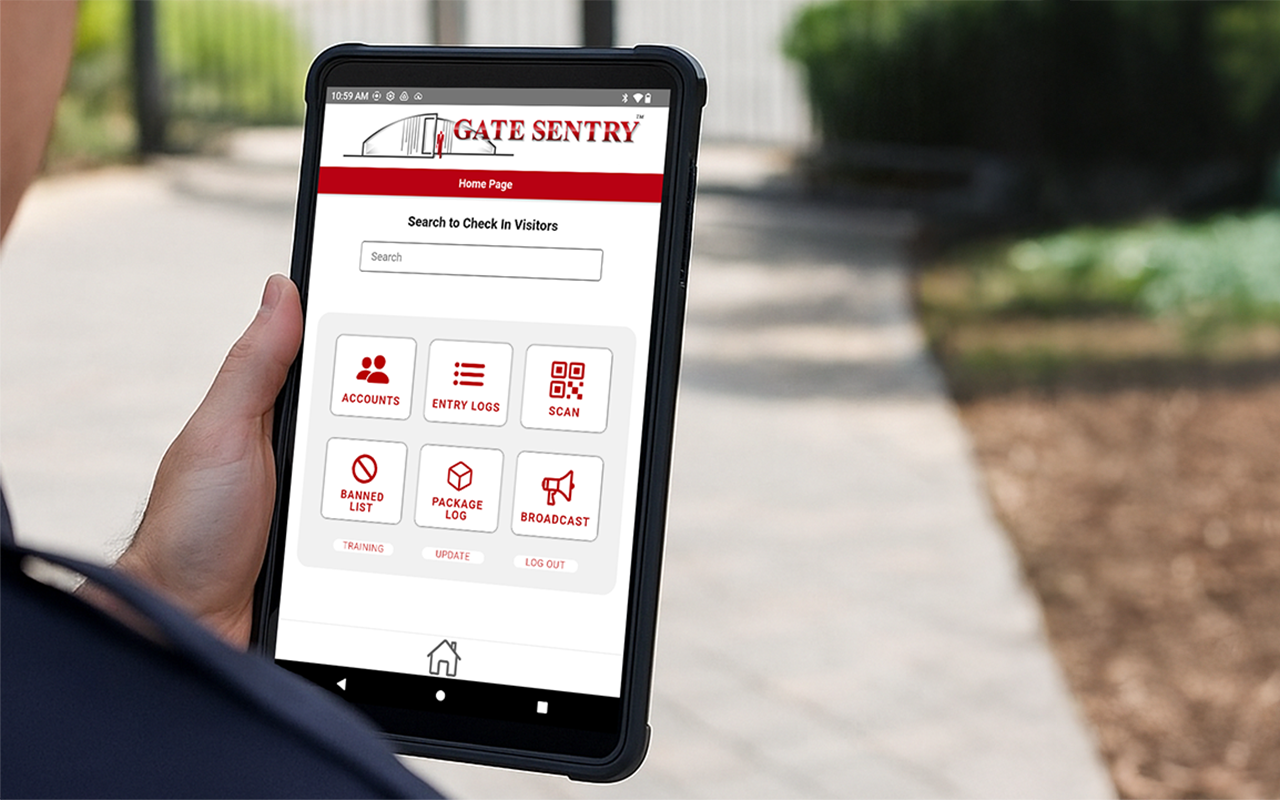
- No hardware to install. Gate Sentry is a SaaS platform that runs on standard tablets. There's no proprietary kiosk or wired badge printer to maintain.
- Built for guard-led verification. The tablet interface is designed for security officers, allowing them to search by name or license plate and verify a visitor in seconds.
- Offline capability. When connectivity drops, the tablet keeps working locally and syncs the moment the network returns.
- Property-wide ban list. One-click enforcement propagates instantly to every gate at every site.
- License plate scanning. Scanning a plate to pull up an approved delivery is faster than typing and creates a defensible record of every vehicle.
- Officer certification and onboarding. Gate Sentry includes a training program for the security officers who actually run the system.
Common questions about manufacturing visitor management
Do we need a visitor management system if we already have access control? Access control governs doors and gates. A VMS governs who is approved to use them, why they're on-site, and what happened during their visit. The two work together.
How long does implementation take? For tablet-based systems with no hardware to install, deployment happens in days, not months.
What about facilities with unreliable internet at the gate? This is where offline capability matters. Look for a system that keeps verifying and logging locally when connectivity drops.
The bottom line
Paper logs and legacy hardware don't make sense in 2026. A manufacturing visitor management system reduces gate delays, eliminates most human error, and gives security leaders the real-time visibility they need.
Sources & References
- National Association of Manufacturers' (NAM) Manufacturing Leadership Council. (2024). Seventy Percent of Manufacturers Still Enter Data Manually.
Ready to modernize your facility's gate access?
Schedule a Gate Sentry commercial demo to see how our tablet-based approach works at your specific site.
Schedule a Commercial Demo