
Security Guards: Biggest Challenges & Software Solutions
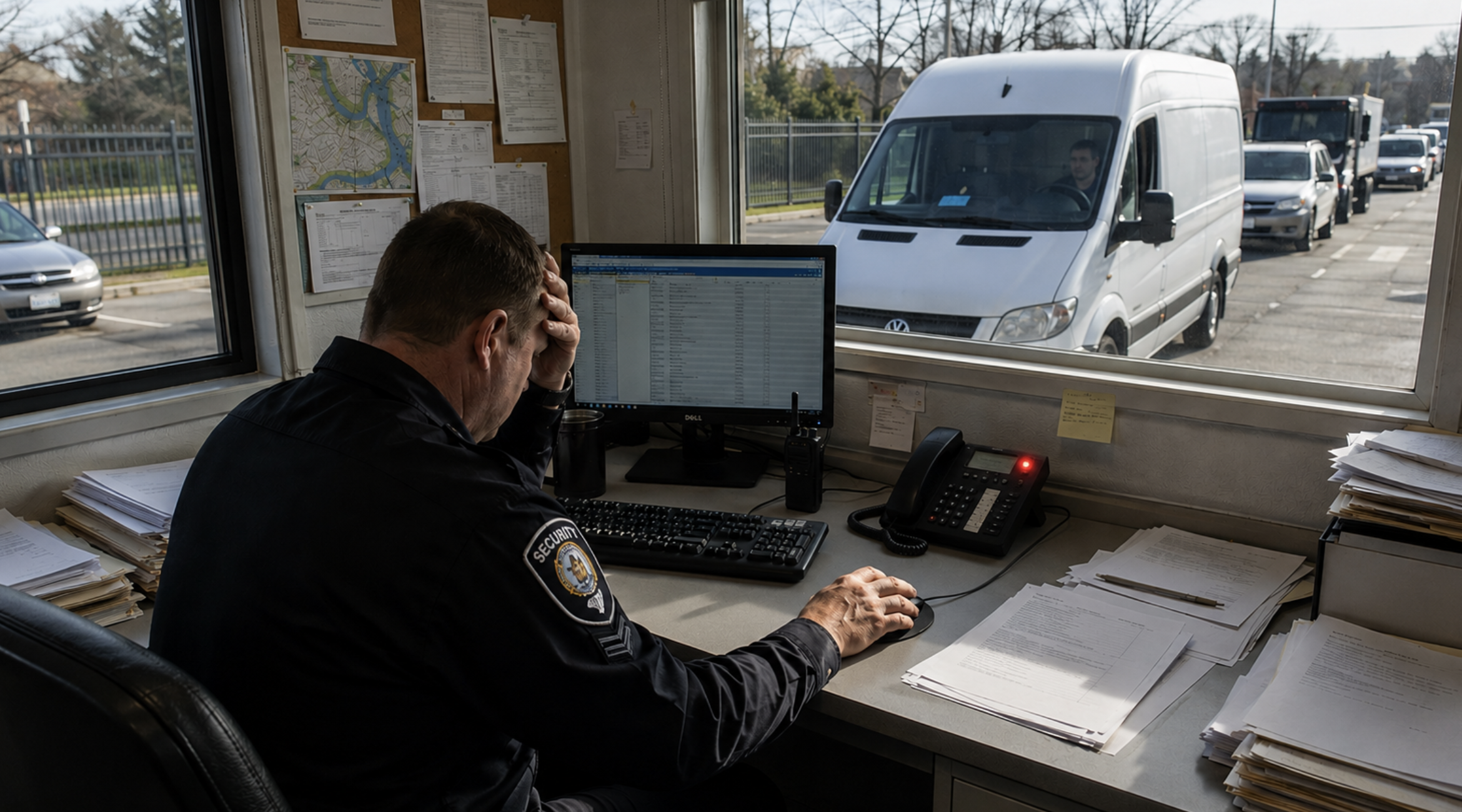
Some of the hardest jobs in private security happen at the gate. The manned entrance of an HOA. The lobby of a condo tower. The access lane of a master-planned community. These posts look quiet from the outside. They feel relentless from the inside.
The HOA security officer is the first person every resident, guest, delivery driver, and contractor sees. They verify visitors. They check names against guest lists. They log license plates. They wave through residents who don't want to wait, and calm the people stacked up behind them who do. They accept packages. They enforce parking and quiet-hours rules. They respond to the occasional real emergency. Often alone. Often overnight. Almost always while someone is unhappy about something.
When everything goes smoothly, nobody notices. When something goes wrong, everyone notices. That pressure is a big reason residential gate posts are some of the toughest to staff and keep staffed in the entire security industry. And it's exactly where the right visitor check-in technology, like Gate Sentry, changes the day-to-day reality for officers, residents, and the companies that serve them.
The Short Version
- The gate is brutal on officers. It's high-friction customer service as much as security, performed alone, often overnight, under constant scrutiny. That concentrates nearly every cause of the industry's turnover into one chair.
- The tools are often the real problem. Paper logs, aging gatehouse PCs, and call-ahead systems turn a manageable job into a stressful one. Fix the workflow and you relieve the single most controllable source of stress at the gate.
- Good officers are the cornerstone, and the hardest thing to keep. A stable, trained guard force protects a property better than a constant churn of new hires, and a revolving door at the gate is a slow-motion liability for the security provider.
- Better check-in plus real training is the highest-leverage fix. Modern visitor management and built-in officer training make the job survivable, which is how you keep good people in the chair.
What This Guide Covers
- Why the residential gate is so hard on officers
- Good officers are the cornerstone, and the hardest thing to hold onto
- Provide adequate training and support for your officers
- Visitor check-in: where the whole experience is decided
- What this means for the officer, the resident, and the board
- Beyond residential: commercial and mixed properties
- Why Gate Sentry fits the residential reality
Why the Residential Gate Is So Hard on Officers
The broader security industry struggles with turnover that runs far above the rest of the economy. Industry estimates put the national annual turnover rate for security officers somewhere between 100% and 300%, a range attributed to the Service Employees International Union, the nation's largest private security officers' union. That means many officers leave within their first year, and some firms effectively replace their entire guard force annually.
Residential and gate posts concentrate nearly every driver of that churn into one chair.
It's high-friction customer service, not just security
A gate officer isn't only watching for threats. They're processing a constant stream of people who want in right now. On a busy Friday evening at a large community, delivery vans, rideshares, and weekend guests stack up while the officer verifies each one. Residents waiting behind an unverified visitor start honking. An unexpected vendor shows up with no record, and if the management office is closed, the officer is stuck. Every one of those interactions is a chance for conflict, and gate officers absorb a heavy load of resident frustration and board complaints that other security roles never see.
Officers are thrown in with too little training and support
This is one of the most overlooked reasons security officers leave. Many states set minimal training requirements, so officers often learn on the job if the employer doesn't train them. And residential posts are full of judgment calls nobody prepared them for. How do you turn away a furious resident's unlisted guest without creating a scene? What do you do with a vendor who has no record and a deadline? How do you de-escalate someone who's been waiting ten minutes and blames you for it?
An officer who was handed a clipboard, a set of keys, and a vague "call the resident if you're not sure" is being set up to fail. So is an officer handed an outdated system that barely works: a slow gatehouse PC, a clunky call box, a paper log that's three names behind. When new hires feel unprepared and unsupported in those first weeks, they disengage fast. And disengaged officers quit. Confidence comes from preparation, and preparation is something employers control.
The hours are long and the friction never stops
Overnight shifts. Holiday coverage. Mandatory overtime to fill open posts. Often it's a one-person gatehouse with no backup, long monotonous stretches broken by sudden high-alert moments. Because understaffing is chronic, the most dependable officers get asked to cover the most gaps, until they burn out. Layer constant low-grade conflict on top of the fatigue, and the job becomes overwhelming. It's not one big crisis that drives officers out. It's the daily grind of long hours, no relief, and one more annoyed person at the window.
The tools are often the problem
Here's the part that doesn't get enough attention. An officer's frustration is frequently a systems problem, not a people problem. Paper logs. Clipboards. Aging gatehouse PCs running unsupported software. Call-ahead systems that require phoning a resident for every single visitor. These turn a manageable job into a stressful one.
Fix the workflow and you relieve the single most controllable source of stress at the gate.
Good Officers Are the Cornerstone, and the Hardest Thing to Hold Onto
An HOA's security, or any property's, is only as good as the person at the gate. The technology. The cameras. The policies. The dues that fund all of it. None of it matters if the officer making real-time decisions is checked out, undertrained, or brand new for the third time this year.
A great gate officer recognizes the regulars. Spots the car that doesn't belong. Reads a tense situation before it escalates. Represents the entire community to every single person who arrives. They are the cornerstone the whole operation rests on. That's exactly why losing them hurts so much.
An experienced officer who knows the residents, the property, and the rhythm of the place delivers a level of safety and service a replacement simply can't on day one. A 2025 systematic review of security-officer retention research made the point bluntly: the effectiveness of a security program is directly tied to the stability of the guard force, and officers with training, experience, and site familiarity provide a higher level of protection than a constant influx of new hires.
The flip side is just as real. When managers are stuck reactively hiring, training, and re-filling shifts, they can't focus on actually protecting the property. Every time an officer walks out, the community loses institutional knowledge, residents notice the unfamiliar face, and the board starts to wonder whether the security provider has things under control. In a business where contracts are renewed on trust, a revolving door at the gate is a slow-motion liability.
And quality guards are brutally hard to retain precisely because the job is so demanding. The officers good enough to handle long hours, constant friction, and isolation with professionalism are the same officers who have the most options to leave for something easier or better-paid. You can't out-discipline burnout. You can't lecture a great officer into staying when the daily experience grinds them down.
Retention isn't about finding people willing to suffer. It's about making the job survivable and respected enough that your best people choose to stay. Pay is part of that. So is training, support, predictable scheduling, recognition, and giving officers tools that let them do the job well instead of fighting the job all shift.
Provide Adequate Training and Support for Your Officers
If you want officers to stay, giving them a real training program and ongoing support isn't a nice-to-have. It's the most basic thing you can do. The job is genuinely challenging. Officers routinely step into risky situations, make fast calls about who gets in, and de-escalate people who are angry, impatient, or testing the rules. Nobody handles that well by instinct alone. They have to be trained to recognize and react to the range of scenarios that can threaten the safety of residents, guests, employees, and the property itself. And then supported once they're on post, not left to sink or swim.
The cost of skipping it is predictable. Without consistent training, every officer invents their own version of "the right way." One always calls the resident to verify a guest. Another waves people through if they say they're expected. A third skips steps when the line gets long. Over time, a property ends up with several competing versions of its own security procedure depending on who's working the gate. That inconsistency is exactly where vulnerabilities, complaints, and liability creep in.
Good, accessible training does the opposite. It gives new officers confidence in their first week instead of dread. It sets one clear standard everyone follows. It tells the officer plainly that the company invested in them, which is one of the strongest reasons people stay. Many companies resist this, fearing they'll train someone who promptly quits. The research points the other way. That same 2025 review found employees tend to stay longer once they receive training, and that the money for retention is usually already being spent, just reactively, on endless recruiting rather than proactively, on developing the officers you already have. Shift that spending from replacing people to preparing them, and the math tends to favor retention.
This is also where the right platform does double duty. Gate Sentry includes a Security Training Portal built specifically for visitor management and gate operations. It's designed around a simple idea: officers should learn the job and prove the job, while supervisors get full visibility without chasing paperwork.
For officers: training that actually sticks
Officers move through ten focused video modules, from tablet basics to guest logging to device management. Each one ends in a knowledge check that requires 100% mastery to pass. No guessing. No skating by.
- Watch-to-learn, not click-to-skip. Smart playback prevents fast-forwarding, so officers actually absorb the material. They pick up right where they left off if they step away.
- Mastery-based quizzes. Fall short, and a quick rewatch and retake gets them there. Pass, and they move on to the next.
- An automatic certificate. Finish all ten modules and a polished, official Certificate of Completion lands in the officer's inbox. No admin lifting a finger.
- Works anywhere. A clean, mobile-friendly design means officers can train on the tablet, their phone, or a desktop.
For supervisors and admins: command-center control
The same portal gives supervisors and administrators a single dashboard to see everything and manage anything.
- Multi-community management. Oversee every property from one view, or drill into a single community. Built for teams managing many sites.
- Live progress at a glance. Instantly see who's Certified, In Progress, or Not Started, with completion bars, last-active times, and per-module detail.
- Effortless onboarding. Add an officer, auto-generate a secure password, and the welcome email sends itself. Promote, reassign, or reset in two clicks.
- Role-based access, done right. Supervisors, Managers, and Super Admins each see exactly what they should and nothing more.
- Secure credential exports. Need the full roster? A one-time emailed verification code unlocks the download. Bank-grade step-up security, built in.
The payoff ties straight back to retention. New hires can get up to speed in an hour instead of days. Every officer is certified against the same standard, so there's no procedural drift between shifts or properties. Completion records double as proof of training during audits, insurance reviews, or incident investigations. When a new guard can be trained immediately and correctly, team changes stop creating security gaps.
Visitor Check-In: Where the Whole Experience Is Decided
Visitor check-in is the moment that defines how everyone experiences community security. The resident. The guest. The officer. The board. Done badly, it's a bottleneck that generates complaints, traffic, and burnout. Done well, it's nearly invisible.
Modern visitor management software replaces paper logs and callboxes with digital passes and real-time entry tracking. The model platforms like Gate Sentry use looks like this: a resident adds a guest from a phone app or web portal and sets how long access lasts, whether one-time, temporary, or permanent. The visitor receives a digital pass (Gate Sentry calls it SentryPass) by text and email that saves to Apple Wallet or Google Wallet. At the gate, the officer scans it on a tablet and the visitor is verified in seconds. No phone call. No waiting.
If a guest arrives without a pass, the officer uses smart search to look them up by name, license plate, or address. Returning visitors are already on file for faster entry next time. The resident gets an arrival notification. Every entry is logged automatically.
The difference for the officer is dramatic. Instead of being the bottleneck, they become the fast, confident point of contact. The line moves. The honking stops. The complaints to the board taper off. Work that used to feel like an argument becomes a quick, professional exchange.

What This Means for the Officer, the Resident, and the Board
Good visitor check-in technology serves three audiences at once. That's why it does more for retention and contract stability than almost anything short of a raise.
For the security officer
A tablet-based system replaces clipboards, scanners, and bulky hardware with one device that works even when the internet drops. Gate Sentry's tablet apps keep logging offline and sync when the connection returns. Officers verify guests instantly, see live visitor lists that update in real time, and spend their energy on judgment calls instead of phone tag. Less friction means less burnout. Less burnout means officers actually stay.
For residents
It removes the daily aggravations that generate most gate complaints. Guests no longer wait while an officer calls to confirm them. Residents manage their own guest lists from their phones. The old way meant constant phone interruptions every time a guest arrived. The new way checks the guest in and notifies the resident automatically.
For HOA boards and property managers
The payoff is visibility. Instead of a stack of handwritten logs, a board gets a dashboard showing visitor volume, peak traffic times, guard activity, and a searchable entry history. They can broadcast alerts, from a routine pool closure to an urgent evacuation notice, through the same platform residents already use. That's the level of accountability boards now expect. It's what keeps a community confident in the people guarding it.
Beyond Residential: Commercial and Mixed Properties
The same problems show up well outside HOAs. The same playbook applies. Resorts and country clubs. Self-storage facilities. Apartment complexes. Industrial sites. All of them run staffed or semi-staffed entry points where contractors, vendors, members, and deliveries need to be checked in quickly and logged accurately. Commercial and industrial sites in particular need compliance-grade digital entry logs, a defensible record of exactly who was on the property and when.
Gate Sentry extends the same tablet-based check-in, digital passes, and real-time reporting to these settings. For unstaffed access points such as a back gate, a pool, a gym, or an amenity area, its Sentry Solo layer uses mobile entry and app-free QR-code access (VirtualKey and VirtualKeypad) so a resident or authorized visitor can open a gate from a phone without a callbox or fob. For security companies running guards across many sites, a single cloud dashboard gives supervisors real-time oversight of every location from one login.
That cross-property flexibility matters for security firms competing for contracts. Showing a board a live, modern check-in system and real-time dashboards is a sharper pitch than handing over a clipboard. And it's increasingly what wins and renews business.
Why Gate Sentry Fits the Residential Reality
A lot of visitor management tools were originally built for corporate lobbies and retrofitted to gates, where the volume and pace are completely different. Gate Sentry's origin is the opposite.
It was founded in 2015 by Michael Rendon, a former HOA board president who'd lived the paper logs, the long gate lines, the resident complaints, and the security gaps nobody could measure because nothing was tracked. The whole point of the tablet-based design is to take pressure off the officer. Every part of the workflow is shaped around the real, minute-to-minute experience at the gate rather than what looks good in a sales demo.
The platform that grew out of that experience is deliberately hardware-free. No callboxes, keypads, fob readers, or kiosks to install or maintain. It runs in the cloud on tablets and smartphones property teams already own. A few practical points worth knowing if you're evaluating it:
- It works alongside existing gates. You don't rip out gate operators or rewire anything. The software runs independently of the physical gate hardware, and most communities are live within days, with training included for officers, residents, and admins.
- It's built for guard-staffed gates specifically, with fast scan-based check-in, smart search, photo-ID capture, and offline operation for the moments WiFi fails.
- It scales from one property to fifty, spanning gated communities, multifamily, hospitality, self-storage, and commercial sites, and is used by communities across the country.
- Officers get real support, not just software, with onboarding plus the built-in Security Training Portal described above and dedicated help for on-site staff, so the tool actively works against turnover instead of adding to an officer's load.
The Bottom Line
The HOA security officer has one of the hardest, most underestimated jobs in the field. Equal parts security, customer service, and crowd control. Frequently performed alone and under constant scrutiny. Much of the stress that drives officers out of these posts isn't the work itself. It's the outdated tools and the lack of real training that turn a simple check-in into a bottleneck.
Visitor check-in is where a community's security succeeds or fails. Modernizing it is one of the highest-leverage things an HOA, property manager, or security company can do. That's why we built Gate Sentry the way we did. To replace paper logs and phone tag with digital passes, real-time logs, and a tablet that just works. And to back it with a training portal that gets officers confident and certified from day one.
The result is a gate that's faster for residents, calmer for officers, and far more accountable for boards. Across residential, commercial, and mixed properties alike. Better tools and better training at the gate don't just improve security. They make the job survivable. That's how you keep good officers in the chair.
See it for yourself.
Schedule a Gate Sentry demo and we'll show you how visitor check-in and officer training work together to ease the pressure at your gate.
Schedule a Gate Sentry DemoAbout Gate Sentry
Gate Sentry is a hardware-free visitor management and access control platform built for guard-staffed gates and the security companies that run them. It pairs tablet-based check-in, digital passes, and real-time reporting with a built-in officer training portal, and is used by communities across the country. Learn more at gatesentry.com.