
Logistics Visitor Management: Checking In Drivers & Vendors
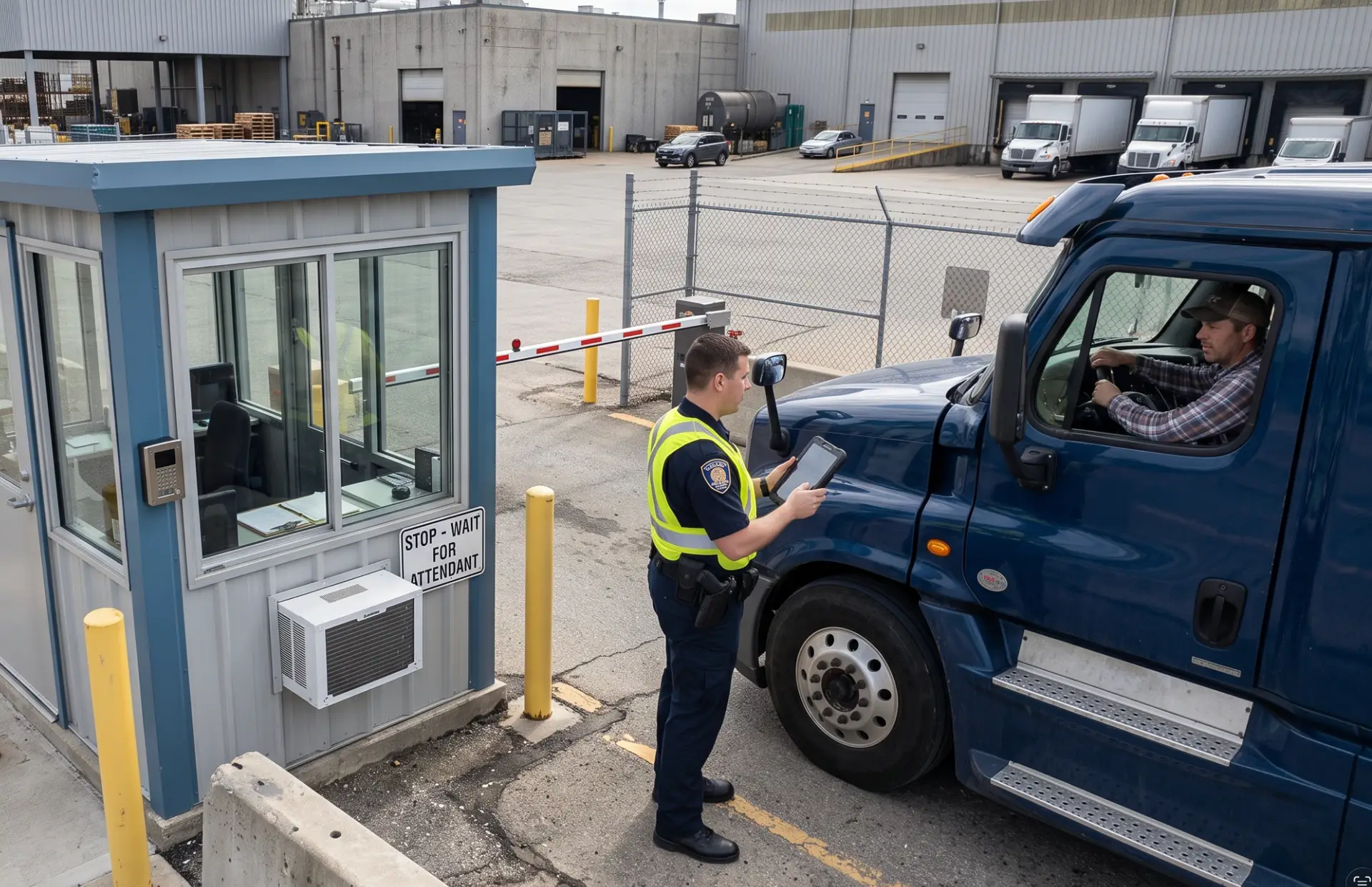
A warehouse we spoke with was processing as many as 200 trucks a day. Their process for tracking drivers was still pretty basic.
"Somebody on a clipboard has to write down a name and a time in and a time out."
That's a lot of handwritten entries for one facility, especially when someone needs to go back and find a particular driver.
We've heard similar things from manufacturing plants, distribution centers, and other industrial properties. Some have guards recording arrivals at the main gate. Others keep a paper log at the loading dock or use a whiteboard to track who's inside.
One facility described its system as:
"A whiteboard with some names to see whether people are in or out."
The problem usually comes up when someone needs information from a previous visit.
A shipment goes missing. A contractor submits an invoice for hours the facility can't verify. Security needs to know which carrier was on-site last Tuesday.
If the only record is a clipboard or whiteboard, finding that information can be difficult.
Warehouse visitor management software gives facilities a way to record driver, vendor, and contractor arrivals digitally, including the information collected at check-in and, when tracked, their departure times.
Why Warehouse Visitor Tracking Gets Complicated
Warehouses deal with a mix of people coming and going throughout the day.
Truck drivers arrive for pickups and deliveries. Maintenance contractors work on equipment. Outside vendors service different parts of the building. Auditors and business visitors may report to the front office.
Some visitors are expected. Others aren't.
One prospective client told us:
"I would say 90% of everybody that's coming to our facility is not scheduled."
That changes how you need to approach visitor management.
A system built around sending invitations and registering every visitor in advance isn't going to cover everything when most drivers arrive without an appointment.
Guards need to be able to process unexpected arrivals, find returning drivers, and collect whatever information the facility requires.
They also need to do it without holding up the line.
What happens when visitor information isn't recorded?
We spoke with a plant administrator about the information her facility collected from visitors.
When asked whether they recorded license plates, she said:
"No license plates, just, um… it's very minimal."
A colleague assumed the log at least included the visitor's company and arrival and departure times.
She corrected him:
"I don't think they're actually even logging that. The only thing that's logged is, like, the paper."
This is something worth checking at any warehouse still using manual logs.
What information is actually being recorded? Is it consistent between shifts? Can someone find it afterward?
A paper log isn't necessarily useless. But if names are incomplete, departure times are missing, or nobody records the vehicle information, those details can't be recovered later.
Checking In Drivers at Warehouse Gates and Loading Docks
For warehouses with staffed entrances, Gate Sentry replaces handwritten visitor logs with tablet-based check-in.
Security officers can record arrivals at the main gate, loading dock, or wherever drivers report when they enter the property.
Scheduled truck drivers
When a driver is expected, the facility can issue a SentryPass before arrival.
The driver receives a digital visitor pass by text or email and can save it to Apple Wallet or Google Wallet.
When they reach the gate, the security officer scans the pass using the Gate Sentry tablet. The scan takes approximately three seconds.
The visitor's information is already associated with the pass, so the guard doesn't need to start a new registration each time.
This can be useful for carriers that visit regularly or drivers whose information has already been collected.
Unscheduled drivers and returning vendors
Not every driver arrives with a SentryPass, and that's fine.
Security officers can check in unscheduled arrivals directly on the tablet.
Depending on the facility's requirements, they can capture identification, record a license plate, and associate the visit with a company.
For returning vendors, guards can search existing records by vendor name or license plate rather than entering everything again.
That's particularly useful at facilities where the same transportation companies make deliveries every week, even if the individual drivers change.
Loading dock check-ins
Some warehouses have drivers report directly to a loading dock or shipping office rather than a main security gate.
A portable tablet allows the person responsible for receiving drivers to record arrivals there.
There's no need to send someone to another building just to complete a visitor log.
With check-out tracking enabled, staff can also record when the driver leaves.
If someone later needs to know when a carrier arrived or whether a driver was still on-site when an issue occurred, those records can be reviewed.
Tracking Contractors and Their Hours On-Site
Contractor visits can be harder to manage than deliveries.
A maintenance project might involve several outside companies working at the facility for weeks. Different subcontractors arrive on different days, and some companies bill according to how long their employees were on-site.
One prospective client explained:
"We might bring in 50… to 60 different subcontractor personnel. And we need to be able to capture the time they arrive at site, and the time they leave."
They also mentioned the number of contractors working at the facility on a typical day.
"Some days there's as many as 20 or 30 people that don't work here, but are doing work here. And a lot of times they bill us based on the number of hours they're here."
For that facility, visitor management wasn't just about security.
They wanted their own record of when subcontractors arrived and departed, rather than relying entirely on the hours reported by outside companies.
With Gate Sentry, contractors can be checked in when they arrive and checked out when they leave.
Administrators can then review the recorded arrival and departure times.
Those records don't prove exactly how many hours someone worked. A contractor might spend part of their visit waiting for equipment or materials. But the facility has a record to reference when reviewing invoices.
Let contractors register ahead of time
Facilities can also collect required information before contractors reach the gate.
With Gate Sentry's visitor self-registration, a visitor receives a text and completes the information the facility requires on their phone.
For visits that start at the front office, Lobby Check In lets visitors register before arriving, including screening questions, signed NDAs or waivers, and photo identification.
For a project involving several subcontracting companies, this can reduce how much information guards need to collect when everyone arrives.
The facility can still verify identification and follow its usual authorization procedures before allowing someone inside.
One Platform for Staffed and Unmanned Warehouse Entrances
One issue we've heard from industrial facilities is that different entrances are often managed through different systems.
The main gate might have visitor management software. Employee parking uses a separate credential system. A contractor entrance has a physical keypad with its own access codes.
That becomes difficult when someone needs to manage access across the property.
For example, a maintenance contractor may need to enter through the staffed main gate on Monday but use a secondary service entrance for the rest of the week.
If those entrances operate on separate systems, someone may need to manage the contractor's permissions in more than one place.
Gate Sentry handles visitor check-in at staffed entrances, while Sentry Solo provides mobile access at compatible unmanned gates and doors.
Both are managed through the same administrator platform.
Here's how that could work at a warehouse or distribution center:
| Entrance | Who Uses It | Access Method |
|---|---|---|
| Main truck gate | Drivers, carriers, vendors | Gate Sentry tablet check-in |
| Loading dock | Delivery drivers, contractors | Gate Sentry tablet check-in |
| Employee parking | Employees | VirtualKey mobile access |
| Contractor service gate | Approved contractors | Sentry Solo VirtualKeypad |
| Secondary visitor entrance | Invited visitors | Sentry Solo SoloPass |
| Front office | Auditors, customers, job candidates | Lobby Check In |
The entrances don't all need the same check-in process.
Security officers can continue checking drivers in at the main gate, while employees and authorized contractors use mobile access at unmanned entrances.
Management can handle permissions, schedules, and recorded activity through one platform instead of maintaining unrelated systems. For more on this, see visitor management and access control for industrial and logistics sites.
Employee entrances
Employees can use VirtualKey in the Gate Sentry app to open authorized gates and doors.
Their access can be assigned according to the entrances they're allowed to use.
Contractor and vendor service gates
At compatible unmanned entrances, Sentry Solo's VirtualKeypad allows contractors to enter without a physical keypad.

The contractor scans the QR code on the SentrySign, which opens a browser-based keypad on their phone.
They enter their assigned access code, and the system checks whether they're authorized to use that entrance.
If the code is valid, the gate opens and the credential activity is recorded.
The QR code itself doesn't grant access, and there's no app to download.
With the Access Scheduler, administrators can limit access by group, entrance, and schedule.
A maintenance crew might have access to a service gate between 7 a.m. and 5 p.m. on weekdays without being authorized to enter overnight.
Invited visitors at unmanned entrances
For occasional guests, SoloPass provides another option.
A visitor receives a mobile pass by text or email and uses it on their phone to open an authorized unmanned entrance.
The pass is tied to the visitor's device and can be issued for temporary or one-time access.
A consultant visiting a secondary building, for example, might receive a temporary SoloPass rather than a recurring contractor code.
What about visitors without access?
At unmanned Sentry Solo entrances with the Intercom configured, visitors without an authorized credential can contact someone at the property.
The facility can decide whether to authorize entry or direct the visitor to a staffed check-in location.
Paper Logs vs. Digital Warehouse Visitor Management
The biggest difference between a paper log and a digital system is what happens after someone signs in.
With paper, the information is only as complete as what someone wrote down, and finding an older record may mean searching through binders or stacks of clipboards.
With a digital system, administrators can search recorded visits and review the information collected at check-in.
| Function | Paper or Clipboard | Gate Sentry |
|---|---|---|
| Driver check-in | Handwritten entry | Tablet check-in or SentryPass scanning |
| Identification | Manually recorded, if required | Optional ID capture |
| License plates | Written down, if required | Optional plate capture |
| Returning vendors | Information may be entered repeatedly | Search existing vendor records |
| Arrival and departure | Depends on staff recording both | Time-stamped check-in and optional check-out |
| Visitor records | Search paper logs | Search digital records |
| Banned carriers | Staff review notices or recognize names | Individual and company bans with tablet alerts |
| After-hours access | Separate gate procedures | Sentry Solo credential activity |
| Multiple properties | Separate logs and systems | One administrator login across locations |
Digital records aren't automatically accurate just because they're digital.
If a guard enters the wrong company or a visitor leaves without checking out, the record will still have limitations.
Facilities need a check-in process that works for their traffic and staff who follow it consistently.
Cargo Theft and Warehouse Visitor Records
Warehouses store valuable inventory while allowing outside drivers, vendors, and contractors onto the property throughout the day.
If something goes missing, security may need to determine which carriers and contractors were present, when they arrived, and which vehicles entered the property.
Cargo theft losses reached nearly $725 million in 2025
Verisk CargoNet reported that estimated cargo theft losses in the United States and Canada reached nearly $725 million in 2025, a 60% increase from 2024, according to The Trucker's coverage.
The average loss per theft rose to $273,990, while confirmed incidents increased 18%.
Those figures cover cargo theft across the supply chain, not just theft occurring inside warehouses.
Fraudulent pickups and carrier impersonation
Cargo theft isn't always someone physically breaking into a warehouse.
Criminals may impersonate legitimate carriers or use fraudulent pickup information to obtain freight.
The National Insurance Crime Bureau has warned about these tactics, including identity theft and fraudulent pickups, as reported by Insurance Journal.
A digital visitor log won't prevent every fraudulent pickup. Facilities still need procedures for verifying drivers, carriers, and shipment release authorization.
But if an incident occurs, having recorded information about the driver, company, vehicle, and arrival time gives security teams something to investigate.
For warehouses still using paper logs, it's worth asking whether those details are consistently recorded in the first place.
What I'd Ask Before Choosing Warehouse Visitor Management Software
If you're evaluating visitor management for a warehouse or distribution center, I'd want to see how the system handles a normal day at your facility.
Not a perfectly scheduled visitor arriving at a quiet front desk.
A driver showing up without an appointment. A returning carrier whose information is already in the system. A contractor who needs access for three days. Someone from a banned company attempting to check in.
Here are the questions I'd ask during a demo:
- How does the system handle unscheduled drivers? Can a guard register someone who arrives without an invitation or appointment?
- Can guards search returning vendors? Can they find records by company, name, or license plate?
- What information can be collected? Can the facility capture identification, vehicle details, and other required fields?
- How are banned carriers handled? Can an administrator restrict an entire company, and what does the guard see during check-in?
- Can the system track departures? What happens when a contractor forgets to check out?
- Does it work during an internet outage? Can guards continue recording check-ins if connectivity drops?
- Can it be used at loading docks? Does the system require a fixed workstation, or can staff use a portable tablet?
- What about unmanned entrances? Can contractors and employees use individual credentials rather than shared gate codes?
- Can access be restricted by schedule? Can someone be authorized for one entrance during a specific work period?
- Can management review multiple facilities? Are records available through one administrator login?
I'd also ask the provider to show how quickly someone can find a visit from several weeks earlier.
If a warehouse is processing hundreds of arrivals every day, searching those records shouldn't become another project.
How Gate Sentry Works for Warehouses
Gate Sentry provides tablet-based visitor management for staffed warehouse entrances, distribution centers, and loading docks.
Security officers can check in drivers, vendors, and contractors without relying on paper logs or a fixed guardhouse computer.
Facilities can use their own compatible tablets or purchase them through Gate Sentry's tablet partner.
The system supports:
- Tablet check-in: Record driver, vendor, and contractor arrivals at staffed entrances.
- SentryPass: Issue digital visitor passes by text or email, with Apple Wallet and Google Wallet support. Pass scanning takes approximately three seconds.
- Visitor self-registration: Let visitors complete the information the facility requires on their phones.
- Optional ID and license plate capture: Collect identification and license plate information according to facility requirements.
- Returning visitor lookup: Search existing records by vendor name or license plate.
- Individual and company bans: Restrict people or entire vendor companies, with alerts during check-in.
- Check-in and check-out records: Record arrival times and departures when check-out tracking is enabled.
- Reporting: Review visitor activity and available operational reports.
- Offline tablet operation: Continue recording check-ins during an internet outage, with records syncing when connectivity returns.
- Multiple locations: Manage several properties through one administrator login.
- Guard training and support: Access a 10-video security officer certification course that takes approximately one hour, along with 24/7 support for security teams.
For compatible unmanned entrances, Sentry Solo provides mobile access for employees, contractors, vendors, and invited visitors.
Both products are managed through the same administrator platform.
Which Warehouses Benefit From Visitor Management Software?
The setup will look different depending on the facility.
A distribution center receiving hundreds of trucks a day has different check-in needs from a cold storage warehouse with a handful of regular carriers.
Some common examples include:
Third-party logistics (3PL) warehouses
Facilities handling inventory for multiple clients may need to identify which carriers, vendors, and contractors were present during a particular period.
Distribution centers
High driver volumes make check-in speed, vehicle records, and searchable visit histories particularly useful.
Cold storage and refrigerated warehouses
Access to temperature-controlled areas may need to be limited to authorized personnel.
E-commerce fulfillment centers
Frequent pickups, deliveries, and outside contractor visits create a steady flow of non-employee traffic.
Industrial warehouses
Maintenance crews, heavy equipment, and valuable inventory make contractor records and access permissions important.
Multi-tenant warehouse complexes
Shared entrances can make it difficult to determine which business authorized a visitor, particularly when each tenant follows a different process.
Gate Sentry supports visitor management for commercial and industrial properties.
Stop Searching Through Paper Logs
The facilities we've spoken with aren't necessarily looking for a complicated new security system. Some just want to know when a driver arrived, when a contractor left, or which company sent someone onto the property. Others are trying to manage staffed gates, unmanned entrances, and employee access without maintaining separate systems for everything.
Gate Sentry gives security officers a way to record visitors at staffed entrances, while Sentry Solo handles authorized access at compatible unmanned gates and doors. Management can review recorded activity and manage permissions from one platform.
If your warehouse is still using clipboards, whiteboards, or separate systems at different entrances, we can walk through how Gate Sentry would work with your existing setup.
Schedule a DemoFrequently Asked Questions
What is a warehouse visitor management system?
A warehouse visitor management system records and manages access for non-employees entering warehouses, distribution centers, and logistics facilities. It can track drivers, vendors, contractors, and other visitors through digital check-ins and searchable records.
How do guards check in truck drivers at a warehouse gate?
With Gate Sentry, guards use a portable tablet to check in drivers. Scheduled drivers can present a SentryPass for scanning, while unscheduled drivers can be registered directly. Facilities can also enable optional ID and license plate capture.
Can a warehouse track when contractors arrive and leave?
Yes. Gate Sentry records arrival times during check-in and can record departure times when check-out tracking is enabled. These records can help facilities review contractor visits and compare reported hours with recorded time on-site.
Can warehouses manage staffed and unmanned entrances in one system?
Yes. Gate Sentry handles visitor check-in at staffed entrances, while Sentry Solo provides mobile access at compatible unmanned gates and doors. Both are managed through one administrator platform.
Can warehouse visitors register before arriving?
Yes. Gate Sentry supports visitor self-registration by text, allowing drivers, contractors, and other visitors to complete the information the facility requires on their phones.
Can a warehouse ban an entire carrier or vendor company?
Yes. Gate Sentry administrators can restrict individuals and entire companies. Security officers receive alerts on the tablet when a matching banned visitor is identified during check-in.
Does warehouse visitor management work when the internet goes down?
Gate Sentry's guard tablet supports offline check-in, allowing security officers to continue recording arrivals during an internet outage. Records sync when connectivity returns. This should not be confused with Sentry Solo's unmanned access operation.
Can contractor access be restricted to certain hours?
Yes. Sentry Solo's Access Scheduler allows administrators to manage access hours by group and entrance, including holiday restrictions and temporary changes.