
Apartment Building Intercom Systems: Types, Tradeoffs and Alternatives
The intercom at an apartment entrance gets a lot of use.
Guests call their friends to be let in. Delivery drivers try to reach the right apartment. Movers, maintenance crews, and cleaners need access throughout the day.
When something stops working, residents notice pretty quickly.
Sometimes it's an outdated directory. A visitor searches for someone who moved out months ago, or a resident changes their phone number and the system keeps calling the old one. Other times, the speaker barely works or calls don't go through at all.
For property managers, it's one more system to maintain, especially in buildings where people are constantly moving in and out.
If you're replacing an old apartment intercom or choosing one for a new building, there are several options worth looking at before investing in another entrance panel.
What Is an Apartment Intercom System?
An apartment intercom system lets visitors contact residents from a building entrance and ask to be let inside.
Traditional systems generally have two basic parts:
- An entrance panel: Usually a directory, keypad, or set of buttons where visitors select the apartment they're trying to reach.
- A way to contact residents: This might be a handset inside the apartment, a phone call, or a mobile app.
Some buildings still have wired handsets in every apartment. Others use telephone entry systems that call residents' cell phones.
Newer options allow visitors to use their own phones instead of interacting with a physical panel at the door.
They all serve the same basic purpose, but the equipment, maintenance, and experience for residents can vary quite a bit.
The Main Types of Apartment Intercom Systems
There are several types of intercom systems used in apartment buildings today.
| Type | How it works | What to consider |
|---|---|---|
| Audio intercom or buzzer system | Visitors press a button and speak with a resident through a handset | Often requires wiring to individual units, and residents generally need to be home to answer |
| Video intercom | Visitors use a camera-equipped panel so residents can see who's calling | Additional equipment, installation costs, and video hardware or app requirements |
| Telephone entry system | Visitors select a directory code, and the system calls the resident's phone | Directory maintenance, telephone connectivity, and potential service fees |
| Wireless or cellular intercom | Uses cellular connectivity to contact residents rather than traditional wired phone lines | Depends on cellular coverage and the system's ongoing service requirements |
| QR code or phone-based intercom | Visitors scan a QR code and use their phones to contact the household | Visitors need a compatible smartphone and sufficient connectivity |
A lot of apartment buildings use a combination of access methods.
Residents might have fobs or key cards to enter the building, while guests use an intercom. Other properties use mobile access for residents and an intercom for unexpected visitors.
The difference is how much work each system creates for management and how convenient it is for the people using it.
What to Compare Before Choosing an Intercom
If you're comparing apartment intercom systems, I'd look beyond the equipment itself.
Some of the biggest differences show up after installation, when management has to update resident information, handle service problems, and answer complaints.
How Easy Is It to Update the Directory?
Apartment residents move in and out regularly, and the intercom directory needs to keep up.
With some older systems, changing a name or phone number isn't as simple as logging in and updating an account.
Management may need to work through the panel's programming process or contact the company that services the equipment.
Before choosing a system, find out whether the leasing office can make those changes directly and how quickly updates appear at the entrance.
What Information Can Visitors See?
Many traditional intercom panels display residents' names next to their apartment numbers.
Some properties don't have an issue with that, but others would rather keep that information private.
Someone standing outside the building may have no reason to know the full names of everyone who lives there.
If resident privacy is a priority, look for a system that allows visitors to search by apartment number or address without displaying personal information.
What Happens When Nobody Answers?
A guest arrives at the building and calls the resident from the intercom.
Nobody picks up.
Maybe the resident is busy, doesn't recognize the number, or simply didn't hear the call.
Now the guest is standing outside trying to reach them another way.
Some intercom systems allow multiple household contacts, while others only call one number.
It's also worth considering whether residents can send access to expected guests ahead of time. Someone coming over for dinner shouldn't necessarily have to call from the entrance when the resident already knows they're coming.
What Equipment Needs Maintenance?
An intercom panel gets used every day, sometimes hundreds of times.
Over the years, buttons wear out, speakers develop problems, and screens or other components may need to be replaced.
For properties with outdoor entrances, weather can add to the maintenance.
Find out what equipment needs to be installed, which parts may require replacement, and who handles repairs.
It's also worth checking whether the manufacturer still supports older models. A system can work for years before one discontinued component makes the next repair much more expensive.
What Happens During an Outage?
Older intercom systems may rely on telephone lines, while newer ones often use internet or cellular connections.
If that connection goes down, visitors may not be able to reach residents through the intercom.
Property managers should know how their system handles an outage and what procedures are available until service is restored.
That includes making sure residents still have an approved way to enter the building.
Does the System Keep Entry Records?
Some apartment intercoms keep very little information about past activity.
Others record calls, access requests, or when an entrance was opened.
Those records can be useful if management needs to review a complaint or determine whether an access request occurred at a certain time.
Just remember that a record showing the entrance opened doesn't necessarily tell you every person who walked inside.
How Does It Handle Deliveries and Vendors?
Residents aren't the only people who need access.
Delivery drivers, maintenance technicians, movers, and cleaners may come through the building several times a day.
If everyone has to call a resident or the leasing office, those interruptions add up.
A system that supports individual vendor credentials or temporary guest access can make things easier, especially for someone who visits regularly.
Instead of calling from the intercom every time, an approved vendor can use their assigned access method during the hours they're authorized to enter.
Condo Buildings Have the Same Questions
Condominium buildings deal with many of the same intercom problems as apartment properties.
Residents need a convenient way to enter, guests need to contact the people they're visiting, and management has to keep the system updated.
The main difference is often who makes the purchasing decision.
At an apartment property, the owner or management company generally chooses the system.
At a condominium, the association board may need to approve the purchase and account for it in the building's budget.
That makes ongoing service costs, maintenance, and the expected lifespan of the equipment especially important.
We cover more of those considerations in our guide to condo access control systems.
Replacing an Old Intercom
Before replacing the entire system, find out what's actually causing the problem.
Is the panel constantly breaking? Are residents having trouble receiving calls? Is the directory difficult to update?
Sometimes the physical entrance is working perfectly well, and the issue is simply the equipment visitors use to contact residents.
In that situation, the building may be able to change its intercom system without replacing the existing door.
The property's equipment still needs to be reviewed for compatibility, but it's worth exploring before assuming everything has to be replaced.
For other options, see Mobile Callbox Alternatives and Video Intercom vs. QR Code Entry Costs.
A Phone-Based Alternative: Sentry Solo's Intercom
Sentry Solo takes a different approach to traditional apartment intercoms.
Rather than installing a callbox with a directory and keypad at the entrance, the property uses a SentrySign QR code.
Visitors scan the sign with their own phones to reach the household they're visiting.
Here's how it works:
- The visitor scans the SentrySign QR code posted at the entrance.
- A page opens in their phone's browser. There's no app to download.
- They select Intercom and search for the apartment or address they're visiting.
- The system calls the household without displaying the resident's name or personal phone number.
- An authorized household contact can approve the visitor and open the entrance remotely when that option is enabled.
Residents can also maintain a Security Call List with more than one contact.
For example, if someone calls an apartment and the first resident doesn't answer, the system can automatically call the next person on the list.
That gives visitors another chance to reach someone without having to start the process over.
Residents and Expected Guests Don't Need to Use Intercom
Intercom is mainly for people who arrive without access already arranged.
Residents, invited guests, and approved vendors have other options with Sentry Solo.
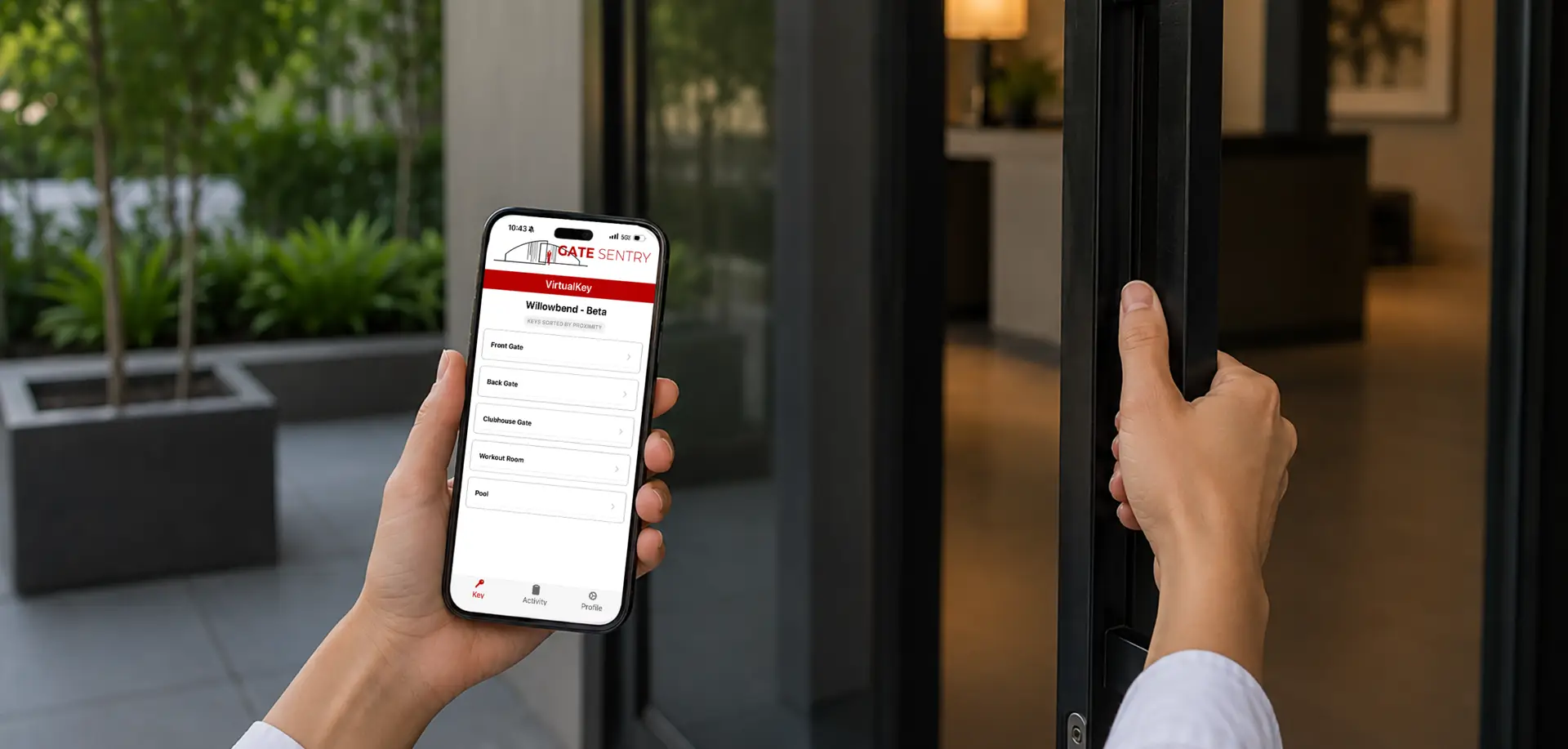
Residents use VirtualKey. Through the Gate Sentry app, residents can open compatible building doors and gates they're authorized to access.
Invited guests can use SoloPass or VirtualKeypad. With SoloPass, a resident sends their guest a link by text or email. The guest completes the initial setup on their phone and taps OPEN when they arrive.
There's no guest app to download or code to remember.
Guests can also use VirtualKeypad. They scan the SentrySign QR code at the entrance and enter their assigned code through the browser-based keypad.
Approved vendors use VirtualKeypad. Cleaning services, maintenance contractors, and other approved service providers can receive their own codes, with access managed according to the property's settings.
For example, a resident having friends over for dinner could send SoloPass ahead of time.
When their friends arrive, they can open the entrance with their passes rather than calling the resident from outside.
If someone shows up unexpectedly, they can still use Intercom to contact the apartment.
What This Means for Property Managers
One of the ongoing frustrations with traditional intercoms is keeping resident information up to date, especially when apartments change occupants.
Someone moves out, but their name is still on the directory. A new resident moves in, and management has to get their information added before visitors can reach them.
With Sentry Solo, resident accounts and access permissions are managed through the administrative portal.
Adding a new resident or updating their information is straightforward, but removing a resident is where the system can save management a lot of work.
When someone moves out, an administrator can remove their account from the Gate Sentry portal in about 10 seconds.
Their access is revoked, along with the active guest and vendor access associated with that resident's account.
Management doesn't have to go through the resident's guest list, cancel individual passes, or figure out which visitors still have working codes.
For an apartment community with residents moving in and out every month, that's a much simpler process than manually updating several different access lists.
The system also records supported access activity for authorized administrators to review.
Because visitors use their phones, there's no traditional callbox or guest-facing keypad to maintain at those entrances.
Sentry Solo does still need to work with the property's existing entrance equipment, and some locations may require additional components.
Why More Properties Are Moving Away From Traditional Intercoms
Traditional intercoms have been used in apartment buildings for decades, but many property managers are tired of maintaining outdated directories, repairing entrance panels, and dealing with residents who can't receive calls.
Replacing an old intercom with another physical panel doesn't necessarily solve those problems.
Management still has a directory to maintain and equipment at the entrance that will eventually need servicing.
With Sentry Solo, visitors use their own phones to contact the apartment they're visiting. Resident information is updated through the admin portal without reprogramming a directory at the entrance.
Residents can also send access to expected guests ahead of time, while approved vendors have their own codes.
When someone moves out, their access and associated active visitor permissions can be removed together rather than having management track everything down separately.
For a property that's already considering a new intercom, it's worth looking at whether another callbox is really necessary.
Frequently Asked Questions
What is an apartment intercom system?
An apartment intercom system lets visitors contact residents from a building entrance to request access. Depending on the system, residents may answer through an apartment handset, phone call, or mobile app.
What's the difference between a buzzer system and an intercom?
The terms are often used interchangeably. A buzzer system usually refers to a traditional audio intercom that connects an entrance panel to a handset or buzzer inside an apartment.
Can an apartment intercom be replaced without replacing the door?
Often, yes. If the existing entrance equipment is compatible and working properly, a property may be able to replace the intercom without replacing the door itself.
Does a QR code intercom show residents' names?
With Sentry Solo's Intercom, visitors search by apartment or address. Residents' names and personal phone numbers aren't displayed in the visitor directory.
What happens to visitor access when a resident moves out?
An administrator can remove the resident's account through the Gate Sentry admin portal in about 10 seconds. The resident's access and active guest and vendor credentials associated with that account are revoked, so management doesn't need to remove each visitor individually.
Can apartment guests enter without calling the resident?
Yes. At compatible Sentry Solo entrances, invited guests can use SoloPass or VirtualKeypad if they've already been given access. They don't need to place an Intercom call.
See How Sentry Solo Works at Apartment Entrances
If your building has an aging intercom or callbox, we can show you how Sentry Solo handles resident access, guest invitations, and visitors who arrive without a pass. We'll also show you how quickly management can add and remove resident accounts and what happens to guest access when someone moves out.
Schedule a Demo